Before the First Splash: A Massachusetts Homeowner's Guide to Pool Safety Fences
Picture the scene. The pool is finished and filled, and one of the kids has already ordered a giant pizza-slice float. The only thing standing between you and summer is a fence. And not just any fence.
For a lot of Massachusetts homeowners, the pool barrier is the final item on the list. That makes sense. Fences aren't exciting, and nobody frames a photo of their gate latch. But in Massachusetts, a pool fence is not optional. Cutting corners can delay your inspection and cost you money. More importantly, it can leave a gap in the fence's most important job: keeping kids safe.
Here's what to know before you build.
Why a Pool Fence Is So Important
Drowning happens quickly and quietly. A small child can wander off in the time it takes to grab a towel or check the grill, and a backyard pool is irresistible to curious kids, along with curious dogs.
A fence that completely encloses the pool is one of the most effective protections available. According to the CDC, a fence that surrounds a pool can cut drowning risk by 83 percent. This is why building officials treat a pool fence very differently from the fence that hides your trash cans from the neighbors.
Does Your Pool Need a Barrier?
Almost certainly. Massachusetts regulates residential pool barriers through the state building code, 780 CMR. Pools that can hold more than 24 inches of water require a compliant barrier. That includes in-ground and above-ground pools, and yes, even those deeper-than-you-think inflatable pools from the home improvement store.
Permits are another area where pool fences are different. A regular backyard fence 7 feet tall or shorter generally doesn't need a building permit under the state code, although many towns enforce their own zoning rules. A pool barrier, however, always requires a building permit. Your local building inspector will also check the barrier.
The Core Requirements, in Plain English
Building code language can make anyone's eyes glaze over. Here's what it means in everyday terms:
- Minimum height: The fence must stand at least 48 inches tall, measured from the finished ground. If your yard slopes, it has to meet that height along its entire length, including at the low spots.
- Gaps: No gap anywhere in the barrier can be large enough for a 4-inch sphere to pass through. That's roughly the size of a small child's head, which explains the rule.
- Climbability: If the horizontal rails are less than 45 inches apart, they must be on the pool side of the fence, so they can't be used as a ladder from the outside.
- Lattice: With lattice or other diagonal patterns, openings can be no wider than 1¾ inches.
- Above-ground pools: When the pool wall itself acts as the barrier, the ladder or steps still need to be enclosed by a compliant barrier. Simply taking away a removable ladder isn't an acceptable substitute.
Remember that the state code is only the starting point. Local communities can layer on their own rules. In Boston, for example, a pool within 10 feet of a property line needs a solid pool fence installation Massachusetts fence at least 6 feet tall. Always check with your local building department, or hire an installer who already knows your town's rules.
The Gate Gets Its Own Set of Rules
If the fence is the nightclub, the gate is the bouncer, and it has to do its job every time. Gates are where most barrier failures happen, because real life happens. Guests haul coolers, juggle toddlers, and forget to pull the gate shut behind them.
This is why Massachusetts lays out detailed gate requirements:
- Walk-through gates must swing outward, away from the pool.
- They must be self-closing and self-latching, so no one has to remember to close them.
- Gates must have room for a locking device.
- Larger gates, like those for equipment access, still need to latch on their own.
- When the latch release sits less than 54 inches from the bottom of the gate, it must be on the pool side, at least 3 inches below the top of the gate. In addition, no opening within 18 inches of the release can be larger than ½ inch. In practical terms, a small hand can't reach through and flip the latch.
Here's a helpful tip: test your gate throughout the year, not just on installation day. New England's freeze-thaw cycles can shift posts and throw hardware out of alignment. The gate that latched perfectly last summer may not latch the same way next year.
Don't Overlook Doors From the House
This one catches a lot of homeowners off guard. If your home's exterior wall forms one side of the pool enclosure, doors that lead from the house into the pool area become part of the barrier. Those doors have extra safety requirements, usually alarms or other approved safeguards. If your back door opens straight onto the pool deck, raise it with your installer or inspector early in the process.
Choosing Between Permanent and Removable Pool Fences
Homeowners ask about this all the time, and the answer is often "both, eventually."
Permanent pool fences form the backbone of a pool safety plan. Usually made of aluminum, vinyl, or ornamental metal, they enclose the whole pool area, stand up to Massachusetts winters, and protect the pool 365 days a year without anyone having to set anything up. In most cases, the permanent fence is the primary barrier that meets the building code.
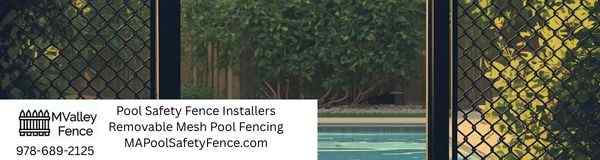
Removable mesh pool fences slide into sleeves installed in the pool deck, generally closer to the water. The see-through mesh lets you keep an eye on the water, and sections can be lifted out for adult parties or at the end of the season. Look for a removable fence built to ASTM F2286, the safety standard for removable pool barriers. Whether a removable fence can serve as your only barrier depends on your town and your property, so check before relying on it by itself.
Plenty of families take a layered approach. The foundation is a permanent fence that encloses the pool area and meets code. Down the road, when the grandkids start visiting, a new baby arrives, or the neighborhood kids discover your pool, a removable fence goes up around the water for an extra layer of protection. The kids can play in the yard, but the pool stays off-limits. On adults-only days, the mesh comes down in just a few minutes.
It's the belt-and-suspenders approach to pool safety, and it's one pool purchase nobody regrets. You might regret the pizza float. You won't regret the fence.
Picking Fence Materials for New England Weather
Massachusetts is hard on outdoor structures. Heavy snow, ice, and constant freeze-thaw cycles all take a toll. Keep these points in mind:
- Aluminum is one of the most popular pool fence materials. It won't rust, it needs almost no maintenance, and its open design lets you see the pool from your window.
- Vinyl provides a clean appearance and privacy styles, but make sure the design doesn't create outside footholds or gaps that fail code.
- Ornamental styles can be stunning, but decorative details still need to follow the rules on openings and climbing.
Regardless of material, proper post installation matters. Posts that aren't set properly can heave in the frost, and a shifted post can leave you with a gate that won't latch or a gap that fails inspection.
What to Ask a Pool Fence Installer
Pool barriers aren't every fence company's specialty. Ask these questions before you sign anything:
- How familiar are you with my town's pool fence rules?
- Who takes care of the permit and inspection?
- What gate hardware do you install, and does it meet the latch requirements?
- How do you handle a sloped or uneven yard?
- Can you add a removable mesh fence down the road?
- How does your schedule line up with my pool installer's timeline?
The right installer will have ready answers. If the phrase "4-inch sphere" gets you a blank stare, keep shopping.
The Takeaway
A pool should be where you relax, not somewhere you nervously watch all afternoon. The right fence is what makes that possible. Get the height right, close the gaps, pay extra attention to the gate, pull the permit, and think about whether a removable fence belongs in your long-term plan.
Then go ahead and inflate the pizza float. You've earned it.
Based in North Andover, Massachusetts, MValley Fence is a fence installation company, specializing in residential fencing, including permanent and removable pool safety fences. The company serves homeowners in Lawrence, Andover, North Andover, Methuen, Haverhill, Amesbury, Merrimack, Lowell, Dracut, Tewksbury, and Tyngsboro. For a pool fence consultation, call 978-689-2125.
87 Union St
North Andover, MA 01845
978-689-2125